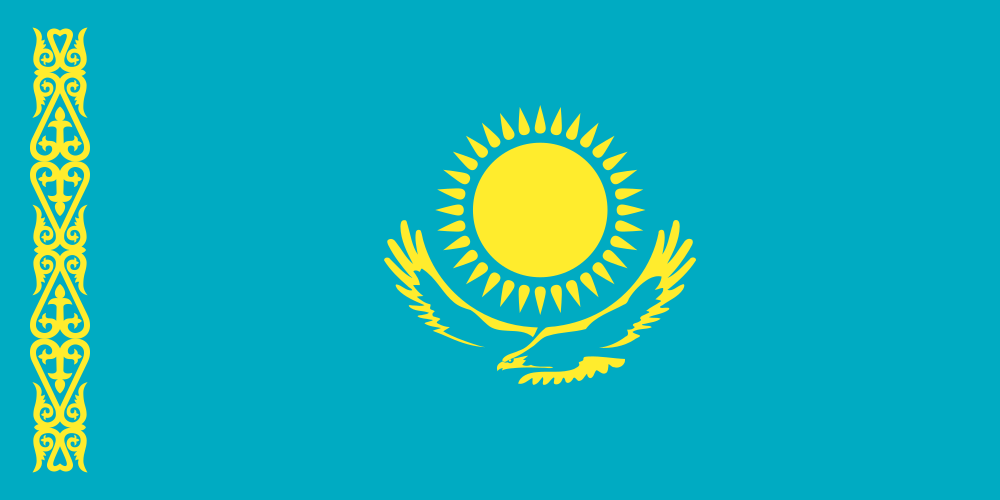
//æsˈtɑːnə// • The Futuristic Heart of Eurasia
Rising dramatically from the vast Kazakh grasslands, Astana is a master-planned showcase of visionary 21st-century architecture and deep-rooted nomadic culture.
Population
6.90 Million
Metropolitan Area
Land Area
810 km²
Territorial Scope
GDP Nominal
$448 Billion
Nominal GDP Hub
Global Rank
No. 622
Global Cities Index
Real-time local weather, live currency rates, and airport transit router.
Perfect time to explore the city! Enjoy walking around Astana and discover its local parks, architectural marvels, and scenic avenues.
~20-40 minutes • Around 0 - 0 KZT
Book via official ridesharing mobile applications where available to ensure fair rates!
~30-50 minutes • Around 0 - 0 KZT • Runs frequently
Direct route connects airport terminal to major central stations.
Astana is a testament to national ambition, having transformed from a modest steppe outpost into a sprawling futuristic capital since 1997. It serves as Kazakhstan's political, cultural, and financial powerhouse.
Eurasian Center
A neutral ground hosting major global peace talks, economic forums, and interfaith congresses.
100K+ Hectares
An ambitious ongoing environmental project planting millions of trees to shelter the city from winds.
130+ Ethnicities
A vibrant melting pot of Kazakhs, Russians, Uzbeks, and expats living in peaceful harmony.
AIFC Platform
The Astana International Financial Centre operates under English common law to attract global capital.
Astana's history is a rapid-fire progression through colonial defense, agricultural expansion, and modern state-building.
Siberian Cossacks establish a military outpost on the Ishim River, which quickly evolves into a key regional trade center.
Soviet leadership renames the town and makes it the heart of the Virgin Lands Campaign, drawing massive agricultural immigration.
President Nursultan Nazarbayev moves the nation's capital from Almaty to the central steppe town of Akmola, renamed Astana.
The city hosts the International Expo 2017 focused on Future Energy, establishing its reputation as a hub for green tech.
After briefly being named Nur-Sultan, the historic name Astana is officially restored to reflect national solidarity and continuity.
Empirical charts mapping local seasonal variations, long-term urban population growth, and economic sector distribution.
Average temperatures (°C) against average monthly rainfall metrics (mm).
Source: Local meteorology department climatology records.
Historical urban concentration of the metropolitan area.
Source: Official national statistics historical database.
Percentage output breakdown of Astana's massive $448 Billion economy.
Source: City Treasury economic forecast index.
Astana is divided by the Ishim River, separating the historic administrative North from the futuristic and opulent South.
Loading district dossier...
Navigate Astana's iconic monuments, royal historical locations, and prestigious world-class museums directly on our live interactive GIS mapping application.
Hover or tap on any of the map markers to read comprehensive descriptions, travel tips, and transport guidelines.
The national monument and observation tower representing the mythical tree of life.
A massive, neo-futurist giant tent housing a shopping mall and indoor beach resort.
From space-age entertainment complexes to massive monuments, explore the structures that make Astana's skyline globally famous.
This 105-meter monument houses an observation deck with panoramic views and a golden handprint of the first President. It embodies the nomadic legend of the Samruk bird and its golden egg.
Designed by Norman Foster, this giant fabric structure houses world-class shopping, a monorail, and a heated indoor beach with sand imported from the Maldives.
An architectural marvel boasting Kazakh national ornaments, a giant dome, and space for up to 10,000 worshippers.
A colossal glass pyramid that acts as a global center for religious tolerance, offering an opera house and museum within.
Left behind from Expo 2017, this 8-story glass sphere explores the future of kinetic, solar, and water-based energy power sources.
A vast, modern museum featuring the 'Golden Man' (Scythian warrior armor) and ancient nomadic artifacts of the Great Steppe.
Kazakh cuisine is traditionally centered around horsemeat, lamb, and dairy, designed historically to sustain nomadic wanderers through harsh winters.
The ultimate national dish, meaning 'five fingers'. Features tender boiled horsemeat or mutton served over thin pastry sheets with onion broth.
Puffy, golden-fried hollow dough balls served at every celebratory table, symbolising warmth and nomadic hospitality.
A traditional, deeply spiced sausage made from cured horse rib meat, usually sliced cold and served as a savory delicacy.
Fermented mare's milk (Kumis) and camel's milk (Shubat) known for their sour fizz and historic health-promoting benefits.
Loading live transit database feed...
Plan your expenditures based on your preferred travel standard, and run live bidirectional currency conversions.
Change value in any currency field below to update all other fields synchronously based on realistic exchange coefficients.
How Astana compares to major financial capitals
| Expense Item | Astana (KZT / USD) | New York City | London | Paris | Tokyo |
|---|---|---|---|---|---|
| Average Mid-Range Dinner | 6,750 KZT ($15) | $45 | $40 | $38 | |
| 1-Bed Apartment (Monthly) | 180,000 KZT ($400) | $3,400 | $2,800 | $1,450 | |
| Single Transit Fare | 110 KZT ($0.25) | $2.90 | $3.50 | $2.30 | |
| Draft Local Beer (0.5L) | 900 KZT ($2) | $8 | $7.50 | $7 |
Spread the knowledge! Share this masterclass encyclopedia of Astana with friends or colleagues.
Have questions about visiting, moving, or living in Astana? Ask local experts and fellow travelers.
View All Discussions →No active discussions for ASTANA yet.
Be the first to ask a question or leave a tip for fellow travelers!
Expand your travel itinerary and economic comparison benchmarks by diving into our detailed GIS guides for neighboring hubs.